

Circa 1250–1350
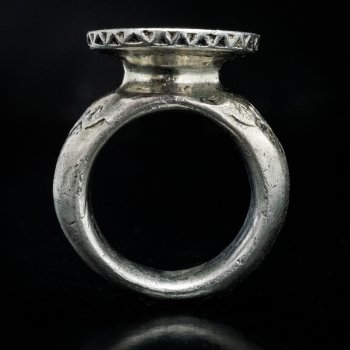
This very rare and important medieval magical or amuletic ring is crafted in high purity silver and partially fire-gilded. The ring is formed in a stirrup shape, a type widely used during the 13th and early 14th centuries. It is surmounted by a silver pyramidal bezel, designed to evoke a diamond crystal in its natural form – an image associated in medieval belief with purity, strength, and spiritual power.
The shank is engraved with five crosses potent and the Lombardic capital letter abbreviation A G L A, a kabbalistic formula used as a talisman for protection against evil spirits.
AGLA is formed from the initial letters of a Hebrew phrase drawn from Kabbalistic tradition: Attah Gibbor Leolam Adonai (with several documented variants), a sacred formula employed by rabbis in exorcistic rituals. The phrase may be translated as “Thou Art Powerful and Eternal, O Lord.”
By the High Middle Ages, AGLA was also adopted into Christian devotional practice and was used to combat evil spirits. The name Agla is recorded in religious usage among the Knights Templar, where it functioned as a protective invocation.
Metal analysis:
pyramidal bezel – 92.13% silver, 2.36% gold, 4.60% copper, 0.91% lead.
shank – 82.22% silver, 11.50% gold, 2.54% mercury, 3.05% copper, 0.69% lead.
Note: The small amount of mercury detected in the metal confirms that the ring was gilded using the ancient technique known as mercury gilding, or “fire gilding,” a process widely employed in the medieval period.
Width of the shank is 4 mm (1/8 in.)
Weight is 3.73 grams
Ring size 8 (18 mm)
Condition: Structurally solid and fully wearable, with some surface pitting consistent with long-term burial and age.
References:
A comparable brooch bearing an AGLA inscription is illustrated in Medieval Jewellery in Europe 1100–1500 by Marian Campbell (p. 90) and is now held in the collection of the Walters Art Museum.
We located three AGLA rings in the collection of the British Museum:
https://www.britishmuseum.org/collection/object/H_AF-1000?selectedImageId=1593634001
https://www.britishmuseum.org/collection/object/H_AF-550
https://www.britishmuseum.org/collection/object/H_1932-0209-1
The British Museum also possesses a medieval ring with a similar pyramidal shaped bezel:
https://www.britishmuseum.org/collection/object/H_1893-0601-258